What’s actually slowing this PC down?
Pick the symptom - the matching free tool is one click away.
Zakir Hussain’s answer was “openness and clarity”: a musical statement should make sense and be delivered without hesitation. In a published interview excerpt, he connects that idea to the time it takes to understand an instrument, the craft of making and repairing tabla, and the improvisational exchange at the heart of Shakti.
What did Zakir Hussain bring to the tabla?
“What do I bring to the tabla? I think it is openness and clarity, and that is what we bring to the audience,” Hussain says in the interview. He explains that a musician’s statement should be intelligible: “your musical statement must be created with as much clarity as possible.” In his account, clarity is not a claim that music must be simple. It is a commitment to knowing what one is saying musically and presenting it without hesitation.
The excerpt appears in Scroll.in’s archive, published December 16, 2024, and is credited to Zakir Hussain: A Life in Music, In Conversation With Nasreen Munni Kabir, a HarperCollins book. It is a published interview excerpt, rather than a separately authenticated transcript. Read the interview excerpt on Scroll.in.
Why does an instrument take time to feel right?
Hussain describes learning an instrument as a relationship, not a quick adjustment. “You need time to build a relationship with your instrument,” he says. A new instrument may need time before it is ready for the stage; his example is a sitar. The point is not a set acclimatization schedule. The player must learn how the instrument responds, while the instrument’s response becomes familiar under the player’s touch.
Quick wins for a faster PC:
Scan for outdated or missing drivers - takes under a minuteDriver Scan →Clear out junk files and repair common Windows errorsFree Scan →Fix the driver behind crashes, sound loss and screen glitchesFind Drivers →#1 Best Overall
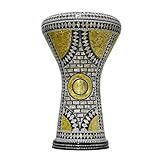
- Arabic drum doumbek , Egyptian handmade Drum Darbuka tabla doumbek inlaid mother of pearl
- Egyptian drum classic model ,,Weight : 5 kgm ,,,,,, Height : 17 Inches (42.5cm),,,,Head Diameter : 10.5 inches (26.25cm),,,,Bottom diameter : 7.5 inches (18.75cm),,,,,Skin head diameter : 8.75 inches
- This is a Top Quality Drum, with a Beautiful Design hand made Egyptian Paintings, which Grants the instrument a Very Authentic Royal Style. The intricate inlay of real mother of pearl and the beautiful shiny patterns, make this drum a real work of art
- Please note that the new logo of Company is a golden circle with the name of the company written in English and Arabic.
He illustrates the idea with a story about tabla maestro Kishan Maharaj, who would say, “Dekhenge bhaiya, aaj tabla kya kehta hai” (“Let’s see, brother, what the tabla wants to say today”). Hussain also recounts Ali Akbar Khan telling sarangi player Sultan Khan, “Sarangi agar theek nahin hai toh kya hua? Haath toh tumhara hai” (“So what if the sarangi is not in good condition? The hand is yours.”). In both anecdotes, the instrument matters, but musicianship is not reducible to equipment.
How does Hussain describe tabla sound and construction?
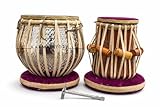
The tabla consists of two drums: the smaller wooden dayan, played with the right hand, and the larger, deeper-pitched metal bayan, played with the left. Hussain’s comments on their skins are personal observations about the response he prefers, not a universal specification for every player or instrument.
Rank #2

- Brass Bayan -Head Diameter 9.5 in// 12 in tall 6.6 lb
- Dayan - Wood-Head Diameter 5.5'' in // 11'' in tall 8.4 lb
- Quality Product crafted in India, Handmade Fine Tabla Set
- Includes: padded tabla gig bag, tuning hammer, high-quality cushions, and covers
- PLEASE NOTE - This is a Handmade Instrument, Minor Nano Scratches/Chips or Dust Might be Present
- Response and resonance: He wants the skin to have enough give to respond and resonate.
- Tonal balance: He listens for bass, treble and mid-range to sit in balance according to his ear.
- Player and skin: In his view, differences in hand pressure affect the skin thickness that suits a player.
These observations explain why a tabla cannot be judged by one isolated construction detail. The sound and feel depend on the interaction between the drum and the person playing it.
Who made and repaired Hussain’s instruments?
Hussain names Haridas Vhatkar as the maker and repairer of his instruments. He describes Vhatkar’s hand work preparing goat skin and buffalo-hide straps, and says Vhatkar had made and repaired his instruments for eighteen years. That duration is Hussain’s figure in the interview, not an independently verified service record.
Rank #3
Hussain contrasts Vhatkar’s work with standard instruments and expresses his own preference for the maker’s craft. That is his assessment, not a controlled comparison or a general finding about instrument quality. He also recounts that during Vhatkar’s visit to America in July 2016, the maker repaired the tablas of forty of Hussain’s students. The number and circumstances are reported in Hussain’s account.
What does Hussain say about other instruments?
The excerpt moves beyond tabla to Hussain’s listening and playing impressions. He discusses the sitar’s combination of melodic and percussive qualities, contrasts his impressions of Ravi Shankar and Vilayat Khan, and recalls becoming more appreciative of the sarod around age twenty-one. These are personal recollections, not a ranking of instruments or musicians. He also describes the shehnai as difficult to play well.
Rank #4

- 3KG black brass bayan, rich resonance and deep sustain.
- Handmade goat-skin puddi, syahi hand-applied and centred by craftsman Md. Ashraf in Delhi.
- Dense Sheesham dayan, 5-5.5 inch head, tuned to C#.
- Two velvet cushion rings, carry bag, tuning hammer.
- Individually tested before packing. Maharaja Musicals, since 1999.
How does Shakti fit into his idea of musical openness?
Hussain presents Shakti as a meeting of musical traditions and a setting for spontaneous improvisation. The interview recounts the collaboration of John McLaughlin, L. Shankar, T.H. Vinayakram (Vikku) and Hussain, bringing together musical contexts associated with North and South Indian traditions and jazz. Hussain emphasizes shared rhythmic understanding and the musicians’ ability to respond to one another in performance.
The excerpt describes four musicians on stage and frames Shakti’s significance through Hussain’s experience. Its broad historical implications, including any suggestion that the group was first to do something, should be understood as his account rather than treated as independently settled music history.
Windows Errors? Fix Them Before They Spread
Repair common Windows errors and clear accumulated junk for a smoother, more stable PC - no reinstall needed.Free scan · no reinstallCrashes, No Sound, or Screen Glitches?
Random freezes, missing sound and display glitches usually trace back to one bad driver. Find and replace yours safely.Free scan · under a minuteQuick Recap
Best Value

- Material: Bongo drums made of high quality, weatherproof and durable wood and metal, which translates to improved sound quality as well as sturdiness and durability. And our tops will not tear out or come apart easily during tuning
- Amazing Sounds: The drum head uses natural animal skins, which makes bongo drums sound crisp, full, and grainy
- Suitable for Beginner: This bongo drums set has no sharp edges, therefore it is particularly safe and will not scratch hands. It is also suitable for beginners, pros, teachers, students and bongo enthusiasts to carry and play
- Ideal Gift: A bongo drum is an ideal music gift, which can stimulate musical talent, portable size, easy to carry and play for indoor and outdoor use
- Package Included: EastRock Mini 4 "+5" bongo drum x 1, adjusting wrench x 1
Product prices and availability are accurate as of the date/time indicated and are subject to change. Any price and availability information displayed on Amazon at the time of purchase will apply.




