Free tools Windows power users keep installed
One-click scans. No signup required.
Abdul Halim Jaffer Khan was an Indian sitarist whose distinctive Jafferkhani baaj joined rhythmic invention and intricate ornamentation with a deep grounding in Hindustani music. He also worked in Hindi film music, founded a sitar academy and collaborated across musical traditions. A 2017 obituary described him as the last of the “four pillars” of sitar’s golden age, alongside Ravi Shankar, Vilayat Khan and Nikhil Banerjee; that is an obituary’s framing, not a formal or universally accepted ranking.
Who was Abdul Halim Jaffer Khan?
Khan came from a hereditary musical family associated with the Beenkar tradition of Indore. His father, Jaffer Khan, was a vocalist who played sitar and been. The Sangeet Natak Akademi identifies his father as Ustad Jaffer Khan of the Bande Ali gharana of Indore.

Published accounts disagree about Khan’s birth year. Scroll and The Times of India give 1927, while the Sangeet Natak Akademi awardee profile gives 1929. His death is recorded by the Akademi as 4 January 2017; The Times of India reported that he died at his Bandra residence after cardiac arrest.
What is Jafferkhani baaj?
Baaj refers to a musician’s distinctive instrumental style. Jafferkhani baaj was Khan’s approach to the sitar, marked by rhythmic play, ornamented phrases and a strong command of the instrument. The Indian Music Archive lists techniques associated with it, including chapka, ulti meend, zamzama, khatka, murki and ghaseet. These ornaments shape and colour a phrase; they are part of the style’s musical vocabulary, not merely displays of speed.
What’s actually slowing this PC down?
Pick the symptom - the matching free tool is one click away.
#1 Best Overall
Khan’s rhythmic inventiveness included subdivisions of the beat and carefully shaped compositions, or gats. He could also play rapid taans across as many as four strings, according to tabla player Nayan Ghosh, who told Scroll, “His speed and clarity were unparalleled.” Sitar player and musicologist Suvranalata Rao told Scroll, “His gats had a unique flavour.”
How did he combine tradition and experimentation?
Khan’s musical foundation came from his family and the traditions he encountered at home, including vocal music and instrumental playing. But he was also receptive to other influences. Scroll recounts his interest in Carnatic music and his use of scales associated with ragas such as Kiravani and Latangi within Hindustani performance.
Rank #2

- Instrument: Persian Quality Setar By Nava
- Bowl: Mulberry, Neck: Walnut, Pegs: Walnut
- Length of Instrument: 86 cm, Length of strings: 66 cm,
- It comes with soft case and extra strings
That openness is also reflected in his exchanges with musicians from other traditions. He worked with Carnatic violinist M. S. Gopalakrishnan and, according to Scroll, collaborated with jazz pianist Dave Brubeck in 1958 and performed with classical guitarist Julian Bream in 1963. These encounters sit alongside, rather than replace, the Hindustani grounding of his sitar music.
Why did he work in Hindi film music?
Khan’s concert career had not yet taken off when his father died, while he was a teenager. Scroll reports that he sought work in Hindi film music, where he had to contend with Western staff notation. He found it difficult at first and made an effort to learn it. Film work was one part of a career that later extended to concert performance, teaching and musical exchange.
Rank #3

- Acoustic-Electric Sitar. Can be played both ways. Comes installed with acoustic strings and a spare electric string set (magnetic strings). Simply change 3 brass strings to convert to electric
- Full cedar wood construction; the best wood for sitars to withstand the high tension created by over 21 Strings! Adds to the life of your Sitar dramatically and also ensures more consistent tuning
- Real bone bridges and brass frets, top of the line.
- 7 Main String RAVI SHANKAR configuration
What did Khan contribute as a teacher?
The Sangeet Natak Akademi profile says Khan established the Halim Academy of Sitar in Bombay in 1976 to provide systematic training to younger musicians. The academy made teaching a direct part of his legacy, alongside his performances and the style he developed.
Independent reader supportYour contribution helps us test, update, and keep practical guides available for everyone.How is he remembered among the major sitarists of his era?
The phrase “four pillars” groups Khan with Ravi Shankar, Vilayat Khan and Nikhil Banerjee as major sitarists of sitar’s golden age. It conveys one obituary’s assessment of his stature, not a settled ranking or a claim that the four played alike. Khan’s place in that company rests on his individual musical voice: a named baaj, distinctive rhythmic and ornamental technique, compositions praised for their flavour, and a career that crossed concert, film and teaching settings.
Rank #4
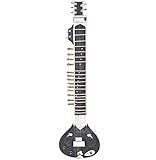
- BRAND NEW ORIGINAL SITAR
- FULLY TUNED, PROFESSIONAL QUALITY - KHARAJA PANCHAM STYLE
- SINGLE TOOMBA SITAR - BLACK COLOR - EXQUISITE CELLULOID WORK - CAMEL BONE BRIDGES
- INCLUDES PADDED GIG/TRAVEL BAG FOR SITAR, MIZRABS AND EXTRA SET OF STRINGS
- INSTRUMENT HAND CRAFTED IN INDIA - PROFESSIONALLY TESTED BEFORE DISPATCH!
Khan received the Sangeet Natak Akademi Award for 1987, as well as the Padma Shri and Padma Bhushan, according to the biographical accounts. The Indian Music Archive lists his book, Jafferkhani Baaj: Innovation in Sitar Music, with Kohinoor Printers and the year 2000; current publication or sales availability is not established.
Quick Recap
Best Value
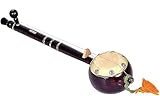
- Sale For - Pack Of 1 | Type - Musical Instrument Iktara
- Material - Wooden | Color - Multicolor
- Item Size - Length - 22 Inches (Approx)
- Pure Handmade Fine Crafted Indian Musical Playing Instruments Wooden Iktara.
- It is used in genres like bhajans, kirtans, and other forms of music.
Product prices and availability are accurate as of the date/time indicated and are subject to change. Any price and availability information displayed on Amazon at the time of purchase will apply.
Do these 3 things before closing this tab:
1Scan for outdated or missing drivers - takes under a minute2Clear out junk files and repair common Windows errors3Fix the driver behind crashes, sound loss and screen glitches



