Crashes, No Sound, or Screen Glitches?
Random freezes, missing sound and display glitches usually trace back to one bad driver. Find and replace yours safely.Free scan · under a minutePC Slower Than It Used to Be?
A free scan shows the junk files, broken settings and background clutter dragging Windows down - then fixes them in one click.Free scan · Windows 10 & 111923’s Teonna and the particular school shown in her story are fictional. But the coercive system behind the storyline was real: U.S. policy supported schools that sought to assimilate Indigenous children, and historical boarding schools operated in Montana. The available sources do not identify the show’s school as a particular real institution or verify every scene.
What is historical—and what is fictional—in Teonna’s story?
Paramount+ describes Teonna as continuing to endure at the hands of Sister Mary, but that is a character and plot in the series, not a documented account of an identified historical student. The official 1923 series page establishes the show’s premise; it does not establish that Teonna or her school represents a specific historical person or institution.
The historical context is well documented. The National Park Service says U.S. government policies established and supported Indian boarding schools across the nation and territories from 1819 through 1969. These schools were intended to assimilate Indigenous children into what European Americans considered “American culture.” Children were often forcibly separated from their families and communities, and schools sought to suppress their languages, religions, and cultural practices. The NPS also records physical and emotional abuse.
That history makes the broad subject of Teonna’s storyline real; it does not make the show’s school, characters, or individual events a verified reconstruction. The sources available do not establish that the fictional school was Fort Shaw, Fort Peck, Carlisle, or another named institution.
Quick wins for a faster PC:
Fix the driver behind crashes, sound loss and screen glitchesFind Drivers →Clear out junk files and repair common Windows errorsFree Scan →Scan for outdated or missing drivers - takes under a minuteDriver Scan →#1 Best Overall
![1923: A Yellowston Origin Story: Season Two [DVD]](https://m.media-amazon.com/images/I/61XZ8vKfxgL._SL160_.jpg)
- Genre: TV Drama
- Number of Discs: 3
- Number of Tracks: 0
- Playback Duration: 456
- Rating: NR
Were there boarding schools in Montana?
Yes. Federal records and National Park Service materials document Montana institutions, though neither source connects them to the school depicted in 1923.
- Fort Shaw Industrial Indian Boarding School: It appears on an 1892 map in an NPS teaching resource about Carlisle and the boarding-school system. The map is evidence of a Montana school, not proof that it inspired the show’s fictional setting. See the NPS lesson on Carlisle and assimilation-era education.
- Fort Peck Agency Boarding School: The federal list gives Poplar, Montana, as its location and 1881–1936 as its operating dates. Those dates describe that school, not the entire system or the fictional school in the series. See the federal list of Indian boarding schools.
Montana’s documented schools make the show’s regional context plausible, but geography alone cannot identify a real-life counterpart.
Rank #2
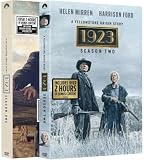
- 1923: A Yellowstone Origin Story: Season One and Two, Complete Box Set, DVD Disc Collection
What did the assimilation system do?
Practices varied by school, but the NPS documents the methods used at Carlisle Indian Industrial School in Pennsylvania. Administrators cut boys’ braids, replaced personal and tribal clothing, assigned English names, prohibited Native languages, and imposed military-style discipline. These are Carlisle-specific examples; they should not be treated as proof that every school operated in the same way or that each practice occurred exactly as dramatized in 1923.
The NPS lesson attributes the phrase “Kill the Indian, and Save the Man” to Carlisle founder Richard Henry Pratt’s assimilation philosophy, and says he presented his thoughts at the 1892 Nineteenth Annual Conference of Charities and Correction. The phrase conveys the ideology associated with the school; it is not evidence about the exact words or events in the series.
Rank #3
![1923: A Yellowstone Origin Story: Season One [DVD]](https://m.media-amazon.com/images/I/41NXkT8NRuL._SL160_.jpg)
- Genre: Drama
- Number of Discs: 3
- Playback Duration: 465
- Rating: NR
- Number of Albums: Yes
What do the figures tell us—and what do they not?
Published totals differ because the sources describe their counts differently. They should be reported with their publishers and scope rather than combined into a single total.
| Source and scope | Reported figure | What it means |
|---|---|---|
| National Park Service, current Carlisle monument history and FAQ pages | 417 schools | The NPS’s stated count for the national system. See its History & Culture page and FAQ. |
| U.S. Department of the Interior, initial Volume 1 findings, published 2022 | 408 federal schools across 37 states or then-territories | An initial federal-system finding summarized on the Department’s Boarding School Initiative page; the Department says its investigation may be expanded. |
| U.S. Department of the Interior, initial Volume 1 findings, published 2022 | Approximately 53 schools with marked or unmarked burial sites | An initial finding that the Department says may expand; it is not a final system-wide count. |
The NPS and Interior figures are not presented on identical terms, so the available statements do not reconcile them into one directly comparable total.
Rank #4

- Yellowstone 1883 DVD Set
- Yellowstone 1923 DVD Set
- Dutton Origin Stories
- 7 DVD Set with Bonus Content
Other widely cited numbers refer specifically to Carlisle, not the whole system. The NPS says about 7,800 children from more than 140 distinct cultures attended Carlisle over nearly 40 years. The school opened in 1879 and closed in 1918. In 2024, Interior estimated that 187 American Indian and Alaska Native children died while attending Carlisle. These are institution-specific figures, not totals for all boarding schools. See the NPS history page and Interior’s October 2, 2024 release.
Independent reader supportYour contribution helps us test, update, and keep practical guides available for everyone.Why is Carlisle often used as an example?
Carlisle Indian Industrial School, in Pennsylvania, was an off-reservation institution and a prominent example of the assimilation model. It was not in Montana, and its history cannot establish what happened at the fictional school in 1923. The NPS lesson and monument history document its practices and chronology; Interior’s 2024 release adds the Department’s estimate of children who died there.
Free tools Windows power users keep installed
One-click scans. No signup required.
Best Value

- Includes all 53 episodes and over 19 hours of special features, with interviews, behind-the-scenes footage, and more.
In the Department’s Boarding School Initiative materials, Deb Haaland, then Secretary of the Interior, described the effects of the policies as including “the intergenerational trauma caused by forced family separation and cultural eradication.” Interior’s initiative examines the historical federal system implemented between 1819 and 1969; that broad period is not the operating span of every individual school.
Where can readers learn more?
The National Park Service’s Carlisle teaching resource includes historical context and points to archival and oral-history resources. Interior’s Boarding School Initiative describes the federal investigation and survivor oral-history work. For a longer historical study, the NPS lesson bibliography lists David Wallace Adams’s Education for Extinction: American Indians and the Boarding School Experience, 1875–1928 (University Press of Kansas, 1995); it provides wider context, not verification of the show’s scenes.
Quick Recap
Product prices and availability are accurate as of the date/time indicated and are subject to change. Any price and availability information displayed on Amazon at the time of purchase will apply.




