An M4A file is an audio file with the .m4a extension. It commonly contains AAC audio, which is lossy, but it can also contain Apple Lossless (ALAC), which is lossless. The extension alone does not tell you which codec is inside or guarantee a particular sound quality. To convert one, choose an output format that the receiving app, device, or service accepts, then export it with a compatible audio program.
What is an M4A file?
M4A is Apple’s audio file type and filename extension. Apple’s developer documentation identifies the type as com.apple.m4a-audio and associates it with the .m4a extension: Apple Developer Documentation.
M4A names the file type, not one particular audio codec. Microsoft documents M4A audio commonly using AAC, while noting that M4A can also contain Apple Lossless. Its documentation lists AAC/M4A and ALAC as separate audio profiles: Microsoft Learn and Microsoft Support.
AAC and ALAC are not the same
- AAC: A compressed, lossy codec. Lossy encoding removes some audio information; Audacity describes AAC as lossy: Audacity audio file formats.
- ALAC: Apple Lossless, a lossless codec. It preserves the audio data in the encoded file rather than using lossy compression.
So “M4A” does not automatically mean lossy or lossless. The codec in the file determines that distinction.
Free tools Windows power users keep installed
One-click scans. No signup required.
#1 Best Overall

- Large Capacity: This mp3 player is designed specifically for music enthusiasts. It has 64GB storage space, which can easily hold thousands of songs, and supports TF card expansion up to 128GB, so you don't need to change songs frequently or worry about insufficient storage space. (TF card is sold separately)
- The latest version of bluetooth : mp3 player Equipped with the latest version of Bluetooth 5.3 MP3 player, which has better compatibility, signal stability, lower power consumption, longer connection distance, and stronger anti-interference ability. (Note: Bluetooth function only supports Bluetooth headset and Bluetooth speaker connection)
- Easy to operate buttons: This reproductor mp3 has several intuitive buttons. Short press “One-Key Sound” can open the music mode, support breakpoint replay function, continue to play from the last exit position; independent volume key can be up and down toggle the precise adjustment of the volume; Short press “Lock Key” can lock the screen, simple and convenient.
- High quality speakers:MP3 player Equipped with high-quality speakers that deliver clear, undistorted sound. No need to wear headphones, you can enjoy music, listen to books or play recording files directly through the speakers. Whether you're relaxing at home, traveling outdoors or sharing music with friends, the speakers will meet your listening needs.
- Upgraded design: MP3 player Length 4.25 inches (10.85 cm), width 1.95 inches (4.96 cm), thickness 0.37 inches (0.95 cm), weight 80.7 grams, equipped with a 2.4-inch color screen to enhance the visual experience and ease of operation; metal alloy shell both durability and comfortable feel, fashionable appearance to adapt to the sports, commuting, travel and other scenarios, carry no burden.
How do I open an M4A file?
Try opening it in the audio player or editor you plan to use. If the app cannot open it, the extension alone may not explain why: the app might not support the codec, or the file may have software restrictions. Audacity says it can import M4A using its optional FFmpeg component, but DRM-protected audio limited to particular software may not be available for import: Audacity’s FFmpeg installation guidance and Audacity file-opening FAQ.
Renaming recording.m4a to recording.mp3 does not convert the audio. A real conversion decodes the source and exports it in a different format.
Rank #2
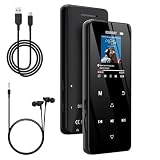
- 🏃【MP3 Player with Bluetooth 5.3 & Wireless Connectivity】 Equipped with Bluetooth 5.3 technology, this MP3 player provides a stable connection to your Bluetooth headphones or speakers. Designed for an active lifestyle, it allows you to enjoy a wire-free experience during workouts, running, or cycling sessions, helping you stay active without the restriction of cables.
- 💾【32GB Internal Memory & 128GB Expandable Slot】 Carry your entire music library with ease. This device features 32GB of built-in storage, enough to store thousands of your favorite songs or audiobooks. For additional space, the integrated MicroSD slot supports expansion up to 128GB (TF card not included), providing ample room for extensive playlists, motivational podcasts, and educational materials.
- 🎵【HiFi Sound Quality & Built-in Speaker】 Enjoy clear audio with support for multiple high-fidelity formats, including FLAC, APE, and WAV. This MP3 player delivers a refined listening experience for all your favorite tracks. For added flexibility, the integrated HD speaker allows you to listen to music or audiobooks without headphones, making it an ideal choice for relaxing at home or sharing stories with family.
- 🛡️【Sturdy Metal Shell & Compact Pocket-Size Design】 Designed for portability and long-term use. Crafted from a zinc alloy, the metal housing provides a solid feel and enhanced durability for an active lifestyle. Its slim profile fits easily into pockets or gym bags, making it a reliable lightweight companion for travel, hiking, or your daily commute.
- 🎁【Complete Gift Set & All-in-One Value】 Looking for a practical gift? This comprehensive set includes 1×MP3 player, 1×Type-C charging cable, 1×User manual, and 1×Wired earphones. It is a thoughtful and functional gift choice for children, students, or music enthusiasts, providing everything needed to start enjoying music right out of the box.
How do I convert M4A to MP3?
First check the destination’s requirements. Use the required format and settings if the receiving service, app, or device specifies them. If it does not, Audacity describes MP3 as widely accepted and provides general guidance for choosing export settings; those examples are not universal requirements: Audacity’s export guidance.
On a Mac: Apple Music or GarageBand
Apple Support names Apple Music and GarageBand as Mac apps that can convert M4A to MP3: Apple Support. The exact steps can depend on the app and installed macOS version, so follow the current instructions for the version you use rather than assuming one menu path applies to every release.
The Tool Desk
Outbyte Driver Updater FREEScan for outdated or missing drivers - takes under a minuteDriver Scan →Outbyte PC Repair FREERepair Windows errors before they cause bigger problemsFix Now →Rank #3

- [Hi-Res Sound with ESS DAC] Built with the ESS ES9018K2M DAC, the H2 delivers clear, detailed sound for serious music listening. It supports DSD128, FLAC, WAV, APE, ALAC and other high-resolution formats, with 107dB SNR and low distortion for a richer experience than standard phone audio.
- [Bluetooth 5.2 Transmitter & Receiver] Enjoy flexible wireless listening with Bluetooth 5.2. The H2 can send music to Bluetooth headphones or work as a receiver for phone audio, with aptX support for cleaner wireless playback. Ideal for commuting, travel, office listening and home audio use.
- [64GB Card Included, Supports up to 512GB] The H2 comes with a 64GB microSD card, so you can start loading your music right away. It supports microSD cards up to 512GB and can read up to about 14,999 songs, making it suitable for large local music collections.
- [USB DAC, Line Out & Headphone Out] Use the H2 as more than a portable MP3 player. Connect it to your computer as a USB DAC, plug in wired headphones through the 3.5mm headphone jack, or use the dedicated line out with car AUX, powered speakers or home audio systems.
- [Zinc Alloy Body with Physical Controls] The solid zinc alloy chassis gives the H2 a premium, durable feel, while the physical buttons and scroll wheel make music control simple without relying on a touchscreen. Up to 10 hours of playback supports daily listening at home, work or on the go.
With Audacity
- Install FFmpeg if needed. Audacity’s documented M4A import and M4A/AAC export workflows use the optional FFmpeg library. If the file cannot be imported or the M4A export option is missing, check Audacity’s current FFmpeg instructions: Installing FFmpeg for Audacity.
- Import the M4A. Open the audio in Audacity. If import fails, check whether FFmpeg is installed and whether the file is DRM-protected.
- Choose MP3 as the export format. Use Audacity’s export workflow to select the destination file and any available audio settings. Audacity’s format guidance explains its export choices: Export formats supported by Audacity.
- Set the audio options for the destination. Follow the receiving service’s instructions when available. If none are provided, Audacity offers general MP3 guidance, including different example bitrate considerations for speech and music; do not treat those examples as a universal standard.
- Export and check the result. Play the exported MP3 in a suitable player and confirm it works for the intended use.
Which format should I convert to?
There is no single best output for every task. Match the format to the destination and whether you need a compressed delivery file or an editing copy.
| Goal | Practical choice | Important point |
|---|---|---|
| Send or upload where the required format is specified | Use the destination’s specified format and settings. | Destination requirements take priority over general recommendations. |
| Share when no format requirement is available | MP3 is a broadly accepted option, according to Audacity. | Choose export settings appropriate to the content and intended use. |
| Keep an uncompressed working copy | WAV can be used as an uncompressed PCM export. | Converting a lossy AAC source to WAV does not restore audio detail already discarded. |
| Keep a compressed file where supported | AAC/M4A may be suitable. | Audacity’s documented M4A export workflow requires FFmpeg. |
These distinctions matter because conversion cannot recover information removed by lossy encoding. Exporting AAC as WAV changes the container/encoding of the output but does not make the original recording lossless. Converting a lossy source to another lossy format can also add another lossy encoding generation.
Rank #4

- A Brand-New Processor That Surpasses Competing Products — Qualcomm Snapdragon 680 Built on a 6nm process, it delivers superior performance and enhanced power efficiency. With 4GB+64GB storage and Android 13, it ensures smooth and seamless operation for all major music apps.
- Patented Desktop Mode with 950mW High Power Output: When Desktop Mode is activated, the M21 operates entirely on external power, with the built-in battery neither charging nor discharging—effectively extending battery lifespan.
- Quad CS43198 Matrix DACs, Fully Balanced 2-Stage Amplification: Featuring a 4-channel, 8-path fully differential output design, it unleashes its full potential with exceptional dynamic range and high noise immunity. The headphone amp adopts a 2-stage circuit design—the first stage handles voltage amplification while the second stage boosts current—ensuring pristine sound quality and rich detail.
- Versatile Ports, High-Performance Output: Supports dual 3.5mm + 4.4mm headphone/LO outputs, equipped with independent line amplification circuits. Also supports SPDIF and USB Audio output, with SPDIF performance rivaling professional digital transports—reducing jitter by 70%.
Is M4A lossless?
Not necessarily. M4A can contain lossy AAC or lossless ALAC. The extension is not enough to determine which one a particular file uses; check the file’s codec details in a media-information tool or the application that opens it. AAC is lossy, while ALAC is lossless, as reflected in Microsoft’s separate AAC/M4A and ALAC profiles and Audacity’s description of AAC: Microsoft Learn and Audacity.
Why an M4A conversion may fail
- The file will not import: Check whether your editor supports the codec and, for Audacity, whether FFmpeg is installed. A DRM-protected file may only work in the software it is licensed for.
- The export format is missing: Some Audacity formats, including M4A, may not appear until FFmpeg is installed. Check the current export-format and FFmpeg documentation before troubleshooting further.
- The converted file will not play at the destination: Confirm the destination’s accepted formats and settings, then export again using those requirements.
- The output sounds no better than the source: Conversion cannot restore detail lost during earlier lossy encoding. Use the original lossless source, if available, when sound preservation matters.
Keep audio conversion separate from YouTube live streaming
If your goal is to make audio work in a player or editor, choose the right audio format and convert it with an appropriate app. If instead you want to keep a YouTube channel live around the clock using uploaded video, that is a separate task. StreamNeo is a cloud service for looping uploaded videos on YouTube; it does not convert M4A audio or stream from a camera. Learn about StreamNeo.
Do these 3 things before closing this tab:
1Scan for outdated or missing drivers - takes under a minute2Clear out junk files and repair common Windows errors3Fix the driver behind crashes, sound loss and screen glitchesOr let it run in the cloud
Upload a recording or build a playlist, add your YouTube stream key, and go live. StreamNeo keeps the uploaded video looping from the cloud, so no computer or home connection has to stay on. It supports what you upload up to 4K 60fps at one flat price per slot, and automatically recovers if YouTube drops the stream. The first day is free with no card; the Monthly price is $9.99 per month.
Quick Recap
Start your free StreamNeo day.
Product prices and availability are accurate as of the date/time indicated and are subject to change. Any price and availability information displayed on Amazon at the time of purchase will apply.