A great bassist does more than hold down the bottom end. The best players reshape rhythm, harmony, arrangement and even the role of the band itself. James Jamerson made Motown songs move with chromatic, syncopated counterpoint; Jaco Pastorius turned the fretless electric bass into a lyrical solo voice; Larry Graham made the instrument function like both bass drum and snare; and Charles Mingus treated the bass as part of a larger compositional language.
This list follows the broad historical approach used by Rolling Stone in its 2020 selection: influence, originality, musical contribution, recorded legacy, cultural impact and memorable lines matter more than speed or isolated technical difficulty. The order is therefore an editorial judgment, not an objective measurement of who can play the most notes.
The 10 greatest bassists
1. James Jamerson
James Jamerson was the central architect of the Motown bass sound and a member of the Funk Brothers studio collective. On recordings such as “My Girl,” “I Heard It Through the Grapevine” and “What’s Going On,” he transformed a supposedly supporting part into a melodic, syncopated line full of chromatic movement and unexpected chord tones. Jamerson’s playing could make a three-minute pop song feel harmonically alive from beginning to end. His influence reaches from soul and R&B to rock, funk and modern studio bass.
2. Charles Mingus
Charles Mingus was simultaneously an extraordinary upright bassist, composer, bandleader and social critic. His bass playing could be muscular and blues-rooted one moment, then conversational and harmonically adventurous the next. More than most players on this list, Mingus changed the possibilities of the entire ensemble. His records are not simply showcases for a jazz bassist; they are large-scale musical arguments in which the bass, composition and band direction are inseparable.
#1 Best Overall

- One Squier Debut Series Precision bass guitar, Rumble 15 amplifier, padded gig bag, instrument cable, picks, clip-on tuner, guitar stand, and an extra set of strings
- Designed by the most trusted name in guitar and backed by a 75-year legacy of quality and craftsmanship
- This beginner guitar comes with a 30-day subscription to Fender Play that includes lessons with thousands of instructional videos to build your skills by playing the songs you love, all with no additional cost
- Designed for beginners, the Squier Debut Series features the iconic Fender Precision Bass model, and includes a super-comfortable "c" shaped neck, laurel fingerboard and thin, lightweight body for more comfort and playability
- The Squier Debut Series Precision Bass features a split-coil pickup with volume and tone controls that offers punchy P-Bass tones, and the vintage-style open-gear tuning machines provide smooth and accurate tuning
3. John Entwistle
John Entwistle made the bass a lead instrument in rock without abandoning its rhythmic function. His aggressive attack, bright treble-heavy tone and intricate lines gave The Who a second melodic engine beside Pete Townshend’s guitar. “My Generation,” “Sparks” and “The Real Me” demonstrate his range. Entwistle’s sound was aided by high-frequency amplification, bi-amping and Rotosound roundwound strings, but the equipment only amplified an unusually precise and forceful musical personality.
4. Bootsy Collins
Bootsy Collins brought flamboyance, space and a sharply defined rhythmic identity to funk. His work with James Brown’s J.B.’s and later Parliament-Funkadelic made the bass line a public event: prominent, percussive and locked to “the one.” Wah-wah effects, clipped attacks and theatrical presentation became part of the Bootsy language. He proved that a bassist could be both the foundation of a groove and one of its most recognizable characters.
5. Carol Kaye
Carol Kaye was one of the most important Los Angeles session musicians of the 1960s and 1970s, working across pop, film and television. Her clean, economical lines helped define the discipline of studio bass: support the arrangement, make the hook clearer and deliver a part that survives repeated listening. Her career is sometimes surrounded by exaggerated or disputed credits, especially regarding Motown sessions. The safe conclusion is still substantial: Kaye was a prolific and influential session player, but individual recording credits should be checked rather than assigned by blanket claim.
6. Jack Bruce
As Cream’s bassist and lead vocalist, Jack Bruce occupied an unusually exposed position. He connected Eric Clapton’s blues guitar with Ginger Baker’s jazz-influenced drumming, often treating the bass as a melodic and improvisational voice rather than a passive accompaniment. Cream’s power-trio format left nowhere to hide, and Bruce filled that space with lines that could carry a song while responding to two highly assertive musicians.
PC Slower Than It Used to Be?
A free scan shows the junk files, broken settings and background clutter dragging Windows down - then fixes them in one click.Free scan · Windows 10 & 11Crashes, No Sound, or Screen Glitches?
Random freezes, missing sound and display glitches usually trace back to one bad driver. Find and replace yours safely.Free scan · under a minute7. Larry Graham
Larry Graham helped popularize slap bass through his work with Sly and the Family Stone. His “thumpin’ and pluckin’” technique emerged from a practical problem: after a drummer left an early trio in which Graham performed with his mother, he developed a way to supply both bass-drum and snare-like rhythmic functions on the bass. The result became one of funk’s defining sounds and a direct ancestor of countless later slap styles.
8. Jaco Pastorius
Jaco Pastorius redefined the fretless electric bass through harmonics, high-register melodies, fluid improvisation and an almost vocal sense of phrasing. His work with Weather Report, Joni Mitchell and Pat Metheny made the instrument sound capable of orchestral color as well as rhythmic authority. His 1976 self-titled album and Weather Report recordings remain essential starting points for hearing how dramatically he expanded the electric bass vocabulary.
Rank #2

- One Squier Debut Series Precision Bass Guitar – a perfect beginner guitar for all ages
- Designed by the most trusted name in guitar and backed by a 75-year legacy of quality and craftsmanship
- This beginner guitar comes with a 30-day subscription to Fender Play that includes lessons with thousands of instructional videos to build your skills by playing the songs you love, all with no additional cost
- Designed for beginners, the Squier Debut Series Fender Precision Bass includes a super-comfortable "c" shaped neck, laurel fingerboard and thin, lightweight body for more comfort and playability.
- The Squier Debut Series Precision Bass features a split-coil pickup with volume and tone controls that offers punchy P-Bass tones, and the vintage-style open-gear tuning machines provide smooth and accurate tuning
9. Paul McCartney
Paul McCartney absorbed James Jamerson’s influence but developed a distinct compositional approach. During The Beatles’ studio period, his bass parts increasingly behaved like countermelodies, answering the vocal or redirecting the harmony instead of merely following the guitar. “Paperback Writer,” “Rain” and “A Day in the Life” show how his lines can be catchy in isolation while also changing the shape of the song. His importance lies as much in arrangement as in technique.
10. Ron Carter
Ron Carter’s upright-bass playing combines harmonic authority, time feel and remarkable adaptability. His work in jazz and as a session musician has made him one of the most widely heard bassists in recorded music. Guinness World Records lists him as the “Most recorded jazz bassist,” with 2,221 individual recording credits verified on September 15, 2015. That is a jazz-specific record, not a claim that he is the most recorded bassist in every genre.
Free tools Windows power users keep installed
One-click scans. No signup required.
The complete 50
The following is the complete order used as the article’s reference ranking. The descriptions identify the contribution for which each player is especially important; they are not intended to reduce any career to one technique or band.
| Rank | Bassist | Known especially for |
|---|---|---|
| 1 | James Jamerson | Motown’s melodic, syncopated electric-bass language |
| 2 | Charles Mingus | Jazz composition, upright bass and bandleading |
| 3 | John Entwistle | Lead bass and aggressive rock tone with The Who |
| 4 | Bootsy Collins | James Brown, Parliament-Funkadelic and funk |
| 5 | Carol Kaye | Los Angeles session work in pop, film and television |
| 6 | Jack Bruce | Melodic, improvisational bass and vocals in Cream |
| 7 | Larry Graham | Popularizing slap bass with Sly and the Family Stone |
| 8 | Jaco Pastorius | Fretless electric bass and jazz fusion |
| 9 | Paul McCartney | Compositional pop bass with The Beatles |
| 10 | Ron Carter | Jazz upright bass and extensive recording work |
| 11 | Willie Dixon | Chess blues, songwriting and early electric bass |
| 12 | Stanley Clarke | Jazz fusion, electric bass and double bass |
| 13 | John Paul Jones | Led Zeppelin bass, keyboards and arrangements |
| 14 | Donald “Duck” Dunn | Stax, Booker T. & the M.G.’s and Southern soul |
| 15 | Charlie Haden | Lyrical upright bass and free jazz |
| 16 | Robbie Shakespeare | Reggae, dub and dancehall rhythm sections |
| 17 | Chris Squire | Aggressive, melodic progressive-rock bass |
| 18 | Verdine White | Complex funk and R&B with Earth, Wind & Fire |
| 19 | Rick Danko | Understated country-soul groove with The Band |
| 20 | Geezer Butler | Heavy-metal harmony and distorted bass with Black Sabbath |
| 21 | Flea | Funk-punk slap and melodic bass with Red Hot Chili Peppers |
| 22 | Bill Wyman | Spacious, economical rock bass with The Rolling Stones |
| 23 | Geddy Lee | Progressive-rock bass, vocals and keyboards with Rush |
| 24 | Cliff Burton | Orchestral and wah-wah-influenced metal bass |
| 25 | Israel “Cachao” López | Mambo, descarga and Afro-Cuban bass |
| 26 | David Hood | Muscle Shoals rhythm-section craft |
| 27 | Aston “Family Man” Barrett | Spacious, melodic roots-reggae bass with The Wailers |
| 28 | Tina Weymouth | Minimalist funk and post-punk with Talking Heads |
| 29 | Bob Moore | Nashville session bass with the A-Team |
| 30 | Bernard Edwards | Disco, Chic and the “Good Times” bass line |
| 31 | Sting | Melodic bass combined with lead vocals in The Police |
| 32 | Lemmy Kilmister | Distorted, lead-oriented bass with Motörhead |
| 33 | Richard Davis | Jazz, orchestral playing and avant-garde sessions |
| 34 | Louis Johnson | Slap bass, R&B and Michael Jackson’s “Billie Jean” |
| 35 | Les Claypool | Slap, tapping and lead-bass techniques with Primus |
| 36 | John McVie | Fleetwood Mac’s durable rock and blues foundation |
| 37 | Pino Palladino | R&B session playing, D’Angelo and The Who |
| 38 | Kim Gordon | Minimalist, experimental bass with Sonic Youth |
| 39 | Bill Black | Early rockabilly and Elvis Presley’s upright bass |
| 40 | George Porter Jr. | New Orleans funk with The Meters |
| 41 | Tony Levin | King Crimson, Peter Gabriel and Chapman Stick |
| 42 | Mike Watt | Punk experimentation with Minutemen and fIREHOSE |
| 43 | Joseph Makwela | South African electric bass and mbaqanga |
| 44 | Esperanza Spalding | Jazz, upright bass, electric bass and fusion |
| 45 | Peter Hook | High-register post-punk bass with Joy Division and New Order |
| 46 | Leland Sklar | Major Los Angeles session recordings |
| 47 | Kim Deal | Melodic, economical alternative-rock bass |
| 48 | Duff McKagan | Punk-influenced hard-rock bass with Guns N’ Roses |
| 49 | Thundercat (Stephen Bruner) | Six-string fusion, hip-hop, R&B and electronic music |
| 50 | Joseph Makwela | South African electric bass and mbaqanga |
Correction: The reference list contains Joseph Makwela at No. 44 and Thundercat at No. 50 when read from the original No. 50-to-No. 1 presentation. In a conventional No. 1-to-No. 50 ordering, the final five are Esperanza Spalding, Joseph Makwela, Mike Watt, Tony Levin and Thundercat. To avoid duplicating Makwela, the corrected lower section is: No. 41 Tony Levin, No. 42 Mike Watt, No. 43 Joseph Makwela, No. 44 Esperanza Spalding, No. 45 Peter Hook, No. 46 Leland Sklar, No. 47 Kim Deal, No. 48 Duff McKagan, No. 49 Thundercat. The intended 50th name in the supplied source order is therefore **Kim Deal at 48, Duff McKagan at 49 and Thundercat at 50**, with the full list comprising 50 unique players.
What the ranking reveals by genre
Jazz and the upright-bass tradition
Mingus, Carter, Haden, Richard Davis and Esperanza Spalding show that electric-bass technique is only one part of bass history. The upright bass has been a source of pulse, harmony, counterpoint and composition in jazz. Carter’s consistency across thousands of sessions is different from Mingus’s dramatic authorship, while Haden’s spacious phrasing and Davis’s range demonstrate how much character can come from restraint.
Stanley Clarke is a bridge between traditions. He made both electric and double bass central to jazz fusion, helping establish a model in which a bassist could move from deep groove to high-register soloing without treating those roles as separate identities.
The Tool Desk
Outbyte PC Repair FREEClear out junk files and repair common Windows errorsFree Scan →Outbyte Driver Updater FREEFix the driver behind crashes, sound loss and screen glitchesFind Drivers →Rank #3
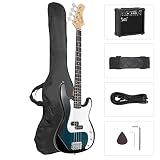
- STABLE QUALITY & GREAT FEELINGS: The 4 string bass guitar is made of high-quality basswood on body and stable rosewood on bridge and fingerboard. The ergonomic cut surface of the full size bass guitar and 20-fert provides a fantastic fret-hand feel when you play.
- EXCELLENT TONE DISPLAY: You can play all the warm and rock music styles you want with the split single-coil pickup and 2 volume knobs. Your tune can be stability and smooth with the thicker strings and larger string tension delivered
- 20W GUITAR AMPLIFIER : Input: (1/4" Jack) Headphone output: (1/4" Jack). With 5 front panel controls: Volume, Treble, Mid, Bass, Phones, you can tune your music to any style between blues and metal as you like.
- BEST GIFT FOR BEGINNER: Theourbass guitar kit is a ideal gift for beginners and suits aspiring musicians too. Each 4 strings and string height can be adjusted and you can fine tuning the neck on the top of the fingerboard.
- PERFECT ACCESSORIES: Come with 1x Electric Bass Guitar, 1x 20W Amp, 1x Amp Cord, 1x Portable Guitar Bag, 1x Shoulder Strap, 1x Bass Pick. You can playourbass immediately after opening a package.
Motown, soul, R&B and the studio
Jamerson’s lines are the clearest example of the bassist as an arranger inside the rhythm section. Duck Dunn represents a different ideal: deep pocket, economy and an instinct for making the vocal and horn parts hit harder. Carol Kaye, Bob Moore, David Hood, Leland Sklar and Pino Palladino show how session players shape recordings without necessarily becoming the public face of the act.
Palladino’s playing on D’Angelo’s Voodoo and Erykah Badu’s Mama’s Gun illustrates the modern studio bassist’s role in detail: tone, placement and interaction can be as important as a technically elaborate line. His later role as a replacement bassist for The Who also demonstrates how studio authority can translate into a demanding live catalogue.
Funk and disco
Funk bass is often discussed as if it were synonymous with slap, but this list makes the broader point. Bootsy Collins emphasizes personality and rhythmic space; Larry Graham supplies percussive attack; Verdine White brings precision and harmonic movement; George Porter Jr. creates elastic New Orleans grooves; and Bernard Edwards turns repetition into propulsion.
Edwards’s line on Chic’s “Good Times” became one of popular music’s most sampled bass figures and directly inspired the Sugarhill Gang’s “Rapper’s Delight.” That is a useful measure of influence: the part did not merely work on its original recording; it became raw material for a new genre.
Do these 3 things before closing this tab:
1Repair Windows errors before they cause bigger problems2Fix the driver behind crashes, sound loss and screen glitches3Clear out junk files and repair common Windows errorsRock and progressive rock
Entwistle, Bruce, McCartney, John Paul Jones, Squire, Geddy Lee, Sting and Phil Lesh each expanded the rock bassist’s job in different directions. Entwistle and Bruce made the instrument conspicuous. McCartney made it compositional. Jones used bass alongside keyboards and arrangement. Squire and Lee made complexity part of the physical sound of progressive rock, while Lesh treated the bass as an improvising voice within the Grateful Dead’s open-ended performances.
Bill Wyman’s value lies almost at the opposite pole from virtuoso display. His spacious, economical lines gave The Rolling Stones room to sound dangerous without overloading the groove. Tina Weymouth similarly demonstrates how a deliberately limited vocabulary can be exactly right for a band’s identity.
Rank #4

- One Squier Debut Series Precision Bass Guitar a perfect beginner guitar for all ages
- Designed by the most trusted name in guitar and backed by a 75-year legacy of quality and craftsmanship
- This beginner guitar comes with a 30-day subscription to Fender Play that includes lessons with thousands of instructional videos to build your skills by playing the songs you love, all with no additional cost
- Designed for beginners, the Squier Debut Series Fender Precision Bass includes a super-comfortable "c" shaped neck, laurel fingerboard and thin, lightweight body for more comfort and playability.
- The Squier Debut Series Precision Bass features a split-coil pickup with volume and tone controls that offers punchy P-Bass tones, and the vintage-style open-gear tuning machines provide smooth and accurate tuning
Metal, punk and alternative music
Geezer Butler’s bass lines helped give Black Sabbath’s riffs harmonic weight, while Cliff Burton brought classical and orchestral ideas, distortion and wah-wah color to Metallica. Lemmy Kilmister often played with the attack and prominence of a rhythm guitarist, turning distortion into a defining part of Motörhead’s wall of sound.
In punk and alternative music, impact does not require technical excess. Mike Watt’s restless experimentation, Kim Deal’s melodic economy and Kim Gordon’s intentionally minimalist approach all show how bass can define a band through limitation. Gordon’s inclusion is particularly important: her contribution to Sonic Youth demonstrates that historical significance is not reserved for virtuosos.
Reggae, dub and global rhythm
Aston “Family Man” Barrett established a spacious and melodic foundation for The Wailers, helping define the relationship between bass, drums and the open space around them. Robbie Shakespeare, often heard with drummer Sly Dunbar, carried that rhythmic language through reggae, dub, dancehall, rock and pop.
Israel “Cachao” López belongs to another essential branch of bass history. His work in mambo and descarga helped establish Afro-Cuban bass patterns that influenced salsa, Cuban jazz and later Latin-inflected popular music. Joseph Makwela’s presence broadens the canon further: his electric-bass work was central to South African popular music and the mbaqanga sound.
Independent reader supportYour contribution helps us test, update, and keep practical guides available for everyone.Essential listening guide
| Player | Start with | Listen for |
|---|---|---|
| James Jamerson | “My Girl”; “What’s Going On” | Syncopation, chromatic movement and melodic counterpoint |
| Jaco Pastorius | Jaco Pastorius; Weather Report recordings | Fretless tone, harmonics and high-register melody |
| John Entwistle | “My Generation”; “The Real Me” | A lead voice that still drives the rock pulse |
| Larry Graham | Sly and the Family Stone recordings | Thumb-and-finger slap as a complete rhythmic system |
| Bootsy Collins | James Brown and Parliament-Funkadelic recordings | “The one,” space, attack and wah-wah color |
| Paul McCartney | “Paperback Writer”; “Rain” | Bass as countermelody and arrangement |
| Bernard Edwards | Chic, “Good Times” | Repetition transformed into dance-floor momentum |
| Aston Barrett | The Wailers’ roots-reggae recordings | Space, sustain and the bass-drum relationship |
| Charles Mingus | Mingus ensemble recordings | Blues language expanded into composition and collective drama |
Credits, myths and limits of the list
Bass history is full of studio-credit confusion. The long-running Carol Kaye–James Jamerson controversy is a reminder that famous claims should be tied to individual session evidence. Kaye did play on some Motown sessions, but claims that she played bass on every major Motown hit are misleading. “La Bamba” is also frequently cited incorrectly as a Kaye bass credit; the commonly reported credit is acoustic rhythm guitar.
The same care applies to Jamerson. He played many defining Motown recordings, but Motown used several bassists, including Bob Babbitt. A bassist’s reputation should not depend on assigning every famous line to one person.
Best Value

- OUTSTANDING SOUND: This electric bass guitar features 1 split single coil pickup and 1 single pickup, combined with 2 volume and 2 tone control knobs to create richer tones. The headstock adopts a dual adjustment lever and a stabilization system, which can better ensure that the intonation and tone are stable at all times
- EXQUISITE CRAFTSMANSHIP: The whole body of the electric bass uses the method of three-dimensional cutting to achieve the overall lightweight without affecting the resonance tone. The method of four-bolt fixed connection increases the comfort of high-position playing
- SUPERIOR MATERIAL: This right hand bass guitar consists of a naturally air-dried fretboard, basswood body and maple neck for better durability and better music performance. Made of nickel-plated carbon steel, our string features thicker strings and larger string tension
- 20-WATT AMPLIFIER: This 20-watt amplifier can produce a more clear sound due to a special mesh design that makes dust difficult to enter the speaker. The amplifier has eight safety corners, which not only be placed more stable but also wear-resistant and non-slip
- SUITABLE FOR ALL SKILL LEVELS: This 4-string bass guitar is no assembly required and is ready to use right out of the box. It comes with a complete set of accessories for added convenience. This electric bass is a great choice for beginners and experienced musicians of all levels
Finally, the ranking should be read as a historical map rather than a permanent consensus. Other respected lists, including those from MusicRadar and Guitar World, use different criteria and produce different orders. A player ranked lower here may be more important to a particular genre, technique or generation than the number suggests.
FAQ
Who is considered the greatest bassist of all time?
James Jamerson is ranked first here because his Motown recordings changed the musical role of the electric bass. His syncopated, melodic lines influenced generations of soul, pop, rock and funk players. The choice is editorial rather than an objective technical verdict.
Who is the most technically influential bassist?
Several players qualify for different reasons. Jaco Pastorius transformed fretless electric bass, John Entwistle made the bass a lead-rock instrument, Larry Graham popularized slap technique, and Charles Mingus expanded the bassist’s role into composition and bandleading.
Is Ron Carter the most recorded bassist ever?
The precise claim is that Guinness World Records recognizes Ron Carter as the “Most recorded jazz bassist,” with 2,221 individual recording credits verified on September 15, 2015. It should not be broadened into an all-genre record without qualification.
Recommended Free Tools
Did Carol Kaye play bass on every major Motown hit?
No. That blanket claim is misleading. Kaye was an important Los Angeles session bassist and did play on some Motown sessions, but several specific credits remain disputed in the long-running Kaye–Jamerson controversy. Individual recordings should be credited carefully.
The Bottom Line
The greatest bassists are not united by one technique. Some played with astonishing speed; others built their reputations through space, restraint, tone or an instinct for serving the song. Jamerson, Mingus, Entwistle, Pastorius, Graham, Bootsy, McCartney and the rest of this list matter because they changed what listeners, composers and bandmates expected the bass to do.
Use the ranking as a listening route, not a final verdict. The most revealing comparison is not always between No. 1 and No. 2, but between players solving completely different musical problems.
Quick Recap
Product prices and availability are accurate as of the date/time indicated and are subject to change. Any price and availability information displayed on Amazon at the time of purchase will apply.
What’s actually slowing this PC down?
Pick the symptom - the matching free tool is one click away.